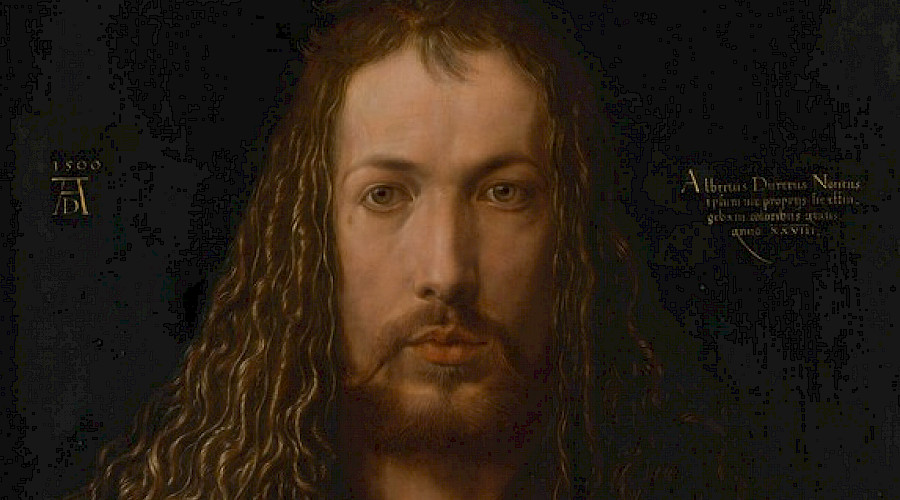
Albrecht Dürer
Albrecht Dürer is considered one of the greatest artists of the Northern Renaissance. He was born in Nuremberg, Germany, on 21 May 1471. His father was a goldsmith, and it was in his workshop that the young Albrecht first learned the precision of drawing and the close attention to detail that would remain central to his work throughout his career. From an early age, he displayed an extraordinary talent. In the workshop of Michael Wolgemut, he discovered woodcut printing, the ancient technique based on engraved woodblocks, which are then inked and printed. His works, both on wood and copper, soon became renowned throughout Europe for their remarkable precision and their ability to convey complex narratives through richly symbolic imagery. From 1490, he embarked on a series of formative journeys through the German-speaking territories. He travelled to Italy on several occasions, particularly to Venice, where his encounter with Renaissance art had a profound impact on him. Dürer succeeded in combining the Northern taste for meticulous detail with the harmonious proportions and ideal beauty of the classical tradition. His prints brought the visionary imagery of Northern Europe to Italy, while introducing the innovations of Italian masters such as Andrea Mantegna and Antonio del Pollaiuolo to Germany. No longer tied to commissions but aimed at a broader audience, his graphic production marked a genuine turning point in terms of quality and originality. From around 1496, Dürer began to sign his works with the distinctive “AD” monogram, a simple yet unmistakable mark that still immediately identifies his work today. Dürer was not only an outstanding printmaker but also a major painter. Among his most celebrated works are the Self-Portrait of 1500, now in the Alte Pinakothek, Munich, and the Adoration of the Magi of 1504, held at the Uffizi Galleries, Florence. Alongside his artistic practice, he pursued rigorous theoretical studies, writing seminal treatises on perspective, the proportions of the human body, and geometry, which went on to influence generations of artists. Albrecht Dürer died in his native Nuremberg on 6 April 1528, leaving a vast legacy that continues to inspire today.