Guercino, Saint Sebastian Tended by Saint Irene, 1619/1620
Guercino, The Sibyl, 1619/1620

Saint Sebastian Tended by Saint Irene was mentioned by the Bolognese art writer Carlo Cesare Malvasia among the works painted by Guercino in 1619 for Cardinal Jacopo, who was the papal legate at Ferrara in those years.
The character stretched out on the ground, wrapped in a blood-stained sheet, is Saint Sebastian, a Roman soldier who was tied to a stake and pierced with arrows to punish his Christian faith.
On the right, a young man supports his head while an old man pulls the arrows from his body. On the left, the particularly beautiful widow Irene, in oriental clothes, takes a sponge from a basin of water to clean his wounds. Surrounded by a ruined building, all the characters in the scene occupy a limited space in the foreground, united by a chain of gestures and expressions: from various drawings, we know that Guercino studied the arrangement of the characters at length, evidence of the meticulous design work that preceded the implementation. The most significant elements of the story are generated in vibrant light bringing forth the dense colours and fluid brushstrokes which convey drama and a strong emotional impact.
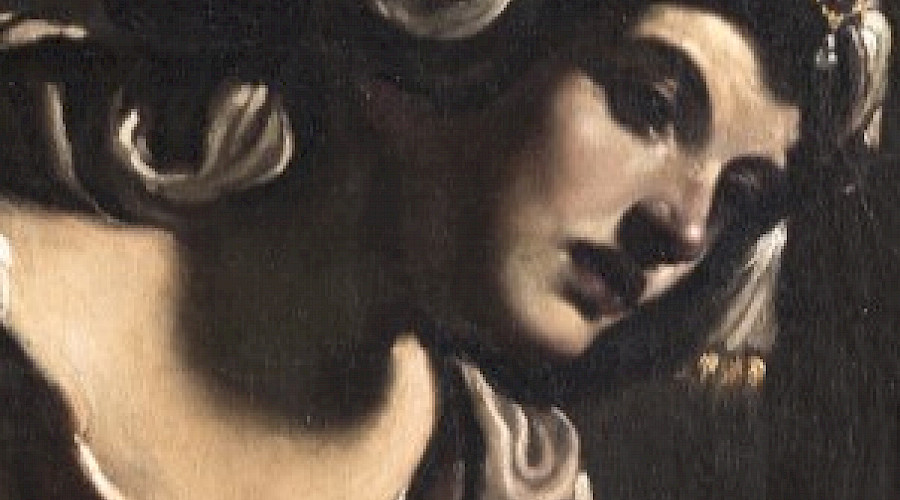
The small canvas exhibited alongside was for a long time believed to be a preparatory study for the figure of Irene but today is considered among the first evidence of reuse by Guercino of the same models for new commissions. Indeed, Guercino replaced the sponge with a scroll in order to transform the woman into an elegant Sibyl, an oriental prophetess with her head adorned with precious jewels, exalted by plays of chiaroscuro.
Next: Saint William of Aquitaine Receiving the Cowl, 1620